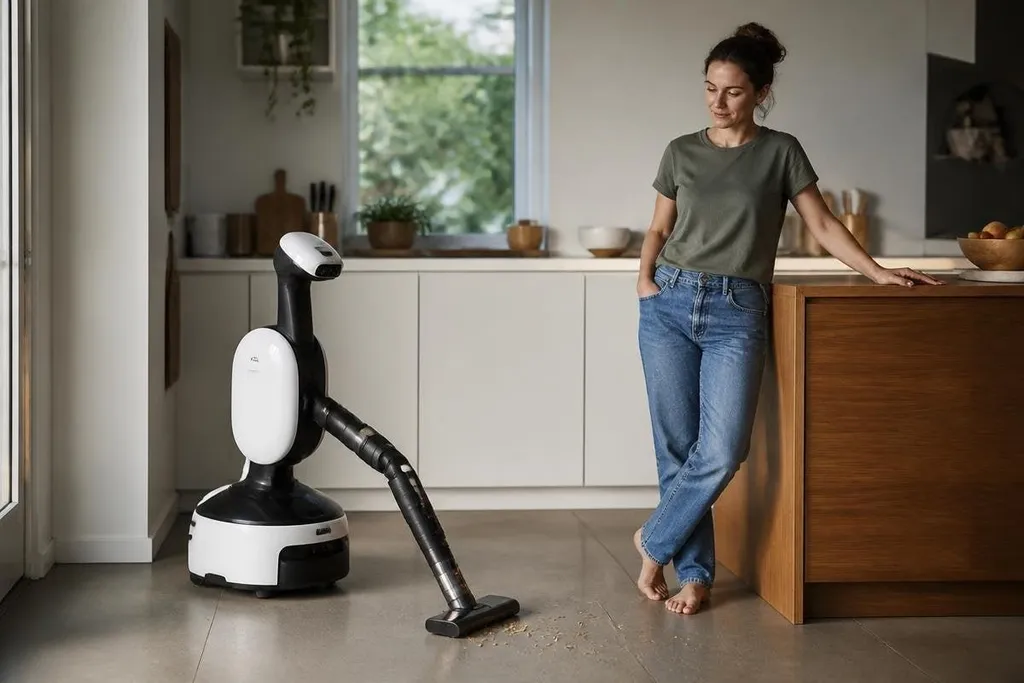
A home robot won't need to do every chore to change daily work. It needs to handle one task, in one room, with fewer mistakes than a person can tolerate.
- Repeated jobs suit robots first, such as vacuuming one floor or carrying a full laundry basket.
- Kitchens and stairs will test gripping, balance, sensing, and safety at the same time.
- The open question is supervision: how often will you need to step in?
Repetition comes first
Household work looks simple from a distance. A robot sees a different problem: objects move, surfaces change, and the same task rarely begins in the same place twice.
Vacuuming offers a clear starting point because the robot can map a floor, follow a route, and return to a charging dock. The job has a defined area and a visible result. Dust remains the harder part to measure, since a clean-looking floor may still need another pass.
Laundry has more steps. A robot would need to find clothing, separate items, lift fabric without dropping it, place clothes inside a machine, and later move them to a dryer or basket.
Each step adds a chance for a failed grip or a blocked path. That pattern points to the first useful jobs: tasks with fixed locations, repeatable motions, and limited contact with fragile objects.
A robot that carries a basket across one floor may be more useful than one that claims to run an entire home.
Why kitchens are harder
The kitchen adds heat, water, sharp tools, food waste, and objects that break. A robot loading a dishwasher must tell a plate from a pan, place each item without contact damage, and leave space for water to reach the surfaces.
A human adjusts without much thought. The robot needs cameras, force sensing, and software that can respond when a cup is wet, a door is partly open, or a spoon has fallen onto the floor.
Cooking creates a higher safety bar. A robot would need to move near a hot surface while keeping its arm, cables, and payload away from heat. It would also need a clear stop response when a person reaches into the same work area.
The household benefit may arrive before full cooking. Sorting food waste, moving dishes, or wiping a clear counter each uses a smaller set of motions. Those jobs still matter because they remove repeated trips from a busy evening.
The robot will need a person nearby
Inside a home, there are no marked lanes and no trained operator. Toys, pets, bags, chairs, and open doors can appear in the robot's path without warning. That makes recovery as important as the first action.
A useful system would show the task it has chosen, pause when its sensors disagree, and ask for help through a phone or a control panel. The person should be able to point to the missed object, confirm a safe route, and let the robot continue from that step.
Before you count a robot’s help as saved time, check how long it worked alone and how often a person intervened. Robot24.com reports on the machines and tests behind those figures, so you can judge what the robot handled without help.
Supervision also changes the cost calculation. If a robot needs help every few minutes, it has moved the work rather than removing it. If it can finish a narrow job for an hour and ask for help once, the same hardware becomes easier to live with.
What could change at home
The first effect may be less bending, carrying, and repeated walking.
A robot could carry laundry between rooms, collect items from a known area, or run a floor-cleaning route while someone handles work or childcare.
That doesn't mean every household needs one. A person in a small apartment may gain little from a robot that needs a clear charging space and careful setup. Someone with limited mobility may value the same carrying task far more.
I'd rather buy a robot that finishes one chore without supervision than one that claims to manage ten tasks and needs help with each of them.
The social effect may be quieter than the sales pitch. A robot could change who does a task, when the task happens, and how much planning it takes. It won't remove the need to keep a home safe, stocked, and organized.
A practical buying check
Before paying for a home robot, check these points:
- Name the task. Pick one job you repeat each week and describe its start and finish.
- Measure the space. Check door widths, floor changes, stairs, cables, and the robot's charging area.
- Count the handoffs. List every moment when a person must move an object, open a door, or clear a path.
- Check the failure response. Find out how the robot stops, reports a blocked route, and resumes the task.
- Price the supervision. Treat your time as part of the cost if the robot needs frequent help.
The useful home robot will arrive through narrow jobs, not a promise to run the whole house. The test is simple to state: can it finish one repeated chore, safely, while you are in another room?